


Everybody’s clowning Arthur. The Miami man who attended an election night watch party for hip hop star-turned congressional candidate Luther Campbell admitted to a local CBS reporter that he didn’t vote in the election he had come to observe the result of.
The replies have been predictably brutal:
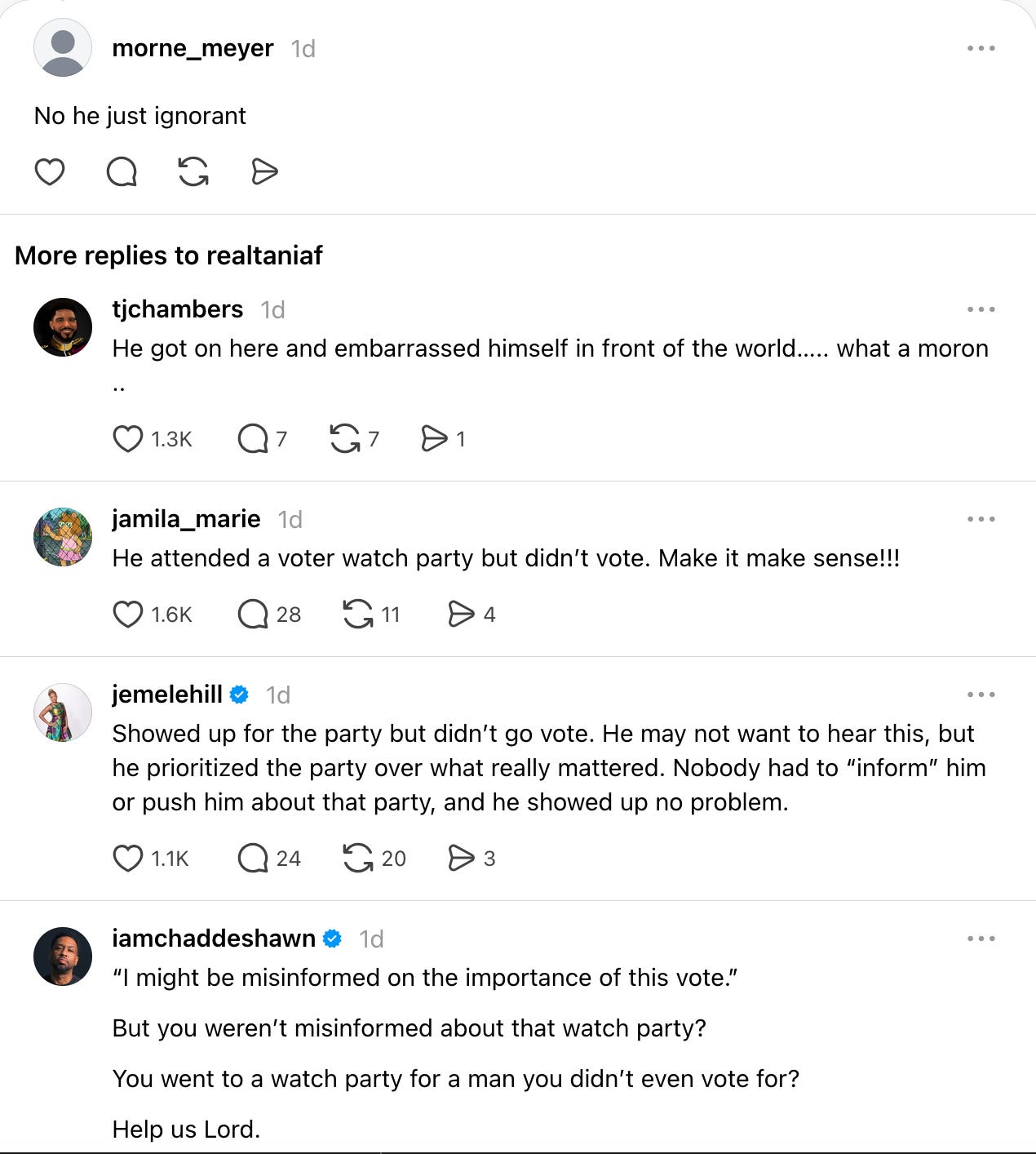
And that’s just a small sample.
So there’s a lot I could say about the choices that news stations make to platform Black people in the most demeaning ways possible. And while I doubt that was the intent of this local reporter, her editors did not have to use a clip of a non-voter. I’m sure the reporter talked to other people. The editorial staff chose to use the clip of Arthur quite intentionally. That’s a whole different post for another day.
But on the point he made in the interview, Arthur is hardly alone. The next set of replies included one that got to the real point.
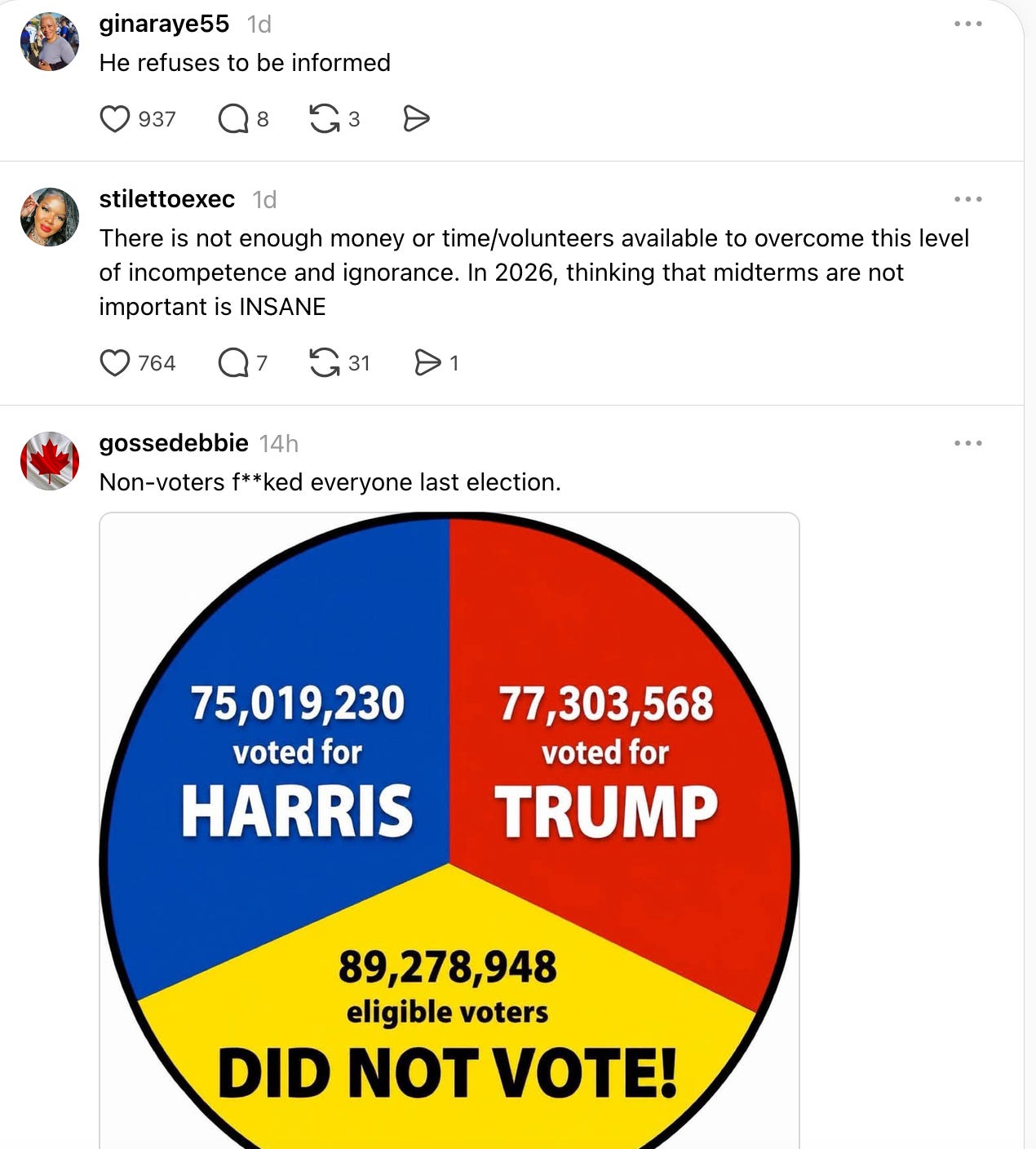
These are indeed the sad and sorry facts about our country:
According to data from the University of Florida Election Lab, approximately 245 million Americans were eligible to vote in the 2024 general election.
This figure is based on the voting-eligible population – not registered voters – in the United States, which the Election Lab defines as “the voting-age population (those 18 years or older in the U.S.) minus ineligible noncitizens and felons.” It is considered a “more consistent” measure of voter turnout, according to the lab.
And while votes are still being counted, preliminary election data shows about 155 million ballots were cast. This would mean an estimated 89 million Americans, or about 36% of the country’s voting-eligible population, did not vote in the 2024 general election.
That makes for an approximate 64 percent turnout — which is actually decent for our relatively low voting nation (though many countries have high turnout due to compulsory voting, which would likely cause another sacking of the capitol if politicians tried to institute that here.)
Arthur is part of the largest group of American adults: those who don’t vote, even if they are eligible and registered. And his framing — that “everybody” knew to come out and vote for Barack Obama is true to my experience in Florida.
In 2008 and 2012, there was a clear reason for people in the Black community, and for a majority of people in the state, period — to turn out for the general election. That reason was Obama. He was the galvanizing force that explained in human form why voting mattered — it mattered because people wanted HIM to be their president. I can remember the 2008 ballot being four full pages long - back and front pages - and the seemingly endless lines that stretched around blocks moving rapidly, because folks were skipping just about everything on the ballot except for voting for Obama for president. I’ll never forget elderly Black women emerging from the African-American Research Library and Cultural Center, which served as an early voting location in Broward County, yelling “Obama!” at the top of their longs and waving their hands in the air as if it was praise and worship at church.
The lesson: compelling personalities can get people to vote if that compulsion and fandom is married to a strong get-out-the-vote and voter education campaign. Which brings us back to Arthur.
Arthur clearly isn’t disinterested. He spoke about civic responsibility. And he showed up, but for Uncle Luke himself, not the election. He came to Uncle Luke’s party. That’s what he cared about. Not the election. Not voting. And not even voting for Luke. He was interested in being part of an Uncle Luke experience.
Politics is like that in America, like it or not.
Most people are attracted to compelling personalities and to the experience of being part of a group. The job of campaigns is to take that desire and hone it into an experience that includes actual voting. The Obama campaigns in 2008 and 2012 were brilliant at that. They had Obama fans throwing Obama barbecues at which they self-distributed Obama merch, Obama talking points and Obama voting schedules. Obama was in young Americans’ video games, reminding them to register and vote. And the campaign relentlessly reminded anyone who took part in those experiences when it was time to register, time to early vote (and by the way, do you need a ride to and from the polls?) and when it was time to vote on Election Day if you hadn’t already voted, and if you had, time for you to bug your family and friends to vote, too. They left nothing to chance. The contacts were relentless to the point of low-key harassing.
But the campaign operated on the recognition that it was not just possible but likely that most Americans who were paying enough attention to politics to know who Senator Obama was and liked him enough to make him president, were still not likely to vote unless repeatedly asked and reminded to.
Welcome to America — a country too distracted, for the most part, to participate in politics.
What the Obama campaign did — and what smart, relentless campaigns like the Zohran Mamdani campaign in New York City have done, is the relentless effort required to take brothers like Arthur and turn them into voters. They don’t need to know everything about civics and politics, but they need to be persistently reminded that fandom is not enough if you don’t also take your behind to the polls and vote to make sure the person you’re a fan of has the power to help change your life. For many in Miami, Luke has already changed their or their sons’ lives through his football programs, or enhanced the fun in their lives through his music. Fewer know that he has gone all the way to the Supreme Court to defend their and their favorite musical artists First Amendment rights. If he ever runs for office again, what he’ll need is the infrastructure — and it’s not cheap — to take the genuine fandom that he experiences in the South Florida streets and turn that into a voting-centered campaign.
Zohran Mamdani and the New York DSA and Working Families Party understood that, too. The Mamdani New York mayoral campaign was a relentless interplay between the creation of fandom — he became a hyper-familiar character online, in TikTok, IG and X-Twitter videos that made him personable, relatable and understandable to the average young New Yorker. And then his campaign spent the money to walk him to seemingly every door of every house and apartment in New York City to ask people to turn their interest into votes, and then reminding them when it was time to vote, what the deadlines were, and why it was important that they follow through. They did that by meeting voters where they were — on social media, and on the streets. And the payoff was real:
5.3 million registered voters (94.3% of eligible voters)
260,000+ new voters, more than double 2021
Youth turnout tripled compared to 2021 (see the chart below).
2.2 million voters participated in the general election.
General election turnout reached 41.6%, the highest in over 50 years for a city election.
Young voters made up nearly two-thirds of all new registrations.
Turnout among voters ages 18-29 tripled since 2021.
In the primary election, young voters had the highest turnout of any group.
Comparison of Voter Turnout by Age Group in 2021 & 2025 General Election
![Table showing percentage point increases in [metric] across age groups from 2021 to 2025, with the largest increase among 18–29 year olds (30.8 points).](https://substackcdn.com/image/fetch/$s_!ffHO!,f_auto,q_auto:good,fl_progressive:steep/https%3A%2F%2Fsubstack-post-media.s3.amazonaws.com%2Fpublic%2Fimages%2Feeed52b6-4e07-4d77-82d5-8d3a02932a90_500x264.png "Table showing percentage point increases in [metric] across age groups from 2021 to 2025, with the largest increase among 18–29 year olds (30.8 points).")
And Mamdani accomplished that without the help of big PAC money:
The winning mayoral campaign was powered by 52,000 small donations.
Public funds amplified grassroots support across the city.
And Mamdani has done something that even Barack Obama failed to do after his 2008 and 2012 victories: he has proven that he can transmit his popularity and the trust his fans/supporters have in him to other candidates, likely sending three of them to the next congress. Mamdani has been so successful, he has caused corporate Democrats to default to mimicking his rhetoric (often cornily) and he’s struck fear into the heart of the AIPAC caucus (and much of the media) as Democratic Socialists like him, and progressives outside the DSA label continue winning and winning and winning.
In the end, elections are just a math problem. The most motivated and largest group of voters will get their way. Unfortunately, in South Florida, it was Debbie Wasserman Schultz’s pro-Israel, pro-status quo voters who had the determination and discipline to follow through, while the majority of those who did bother to turn out couldn’t consolidate around a single champion.
And that includes the vast majority of District 20 registered or eligible voters, who did what Arthur did, and failed to vote at all.
Welcome to American politics.
We can either keep shading people like Arthur, or we can figure out how to engage them and turn their fandom into electoral power that helps us all win. That’s the choice and the lesson in front of us.
Hey while I have you, I’d love for you to please subscribe to The Joy Reid Show on YouTube and hitting the notification bell to make sure you’re always informed when we go live. It’s 100 percent free and it would really help support our independent media venture. If you’re already subscribed here, THANK YOU! If not: please take a few minutes to join as a free or paid subscriber to help us keep the content coming!
Thank you for the article, Miss Joy. Arthur go and vote.