They say history repeats itself every 100 years.
And damned if the 2020s aren’t just the 1920s revisited, only with the party labels flipped.
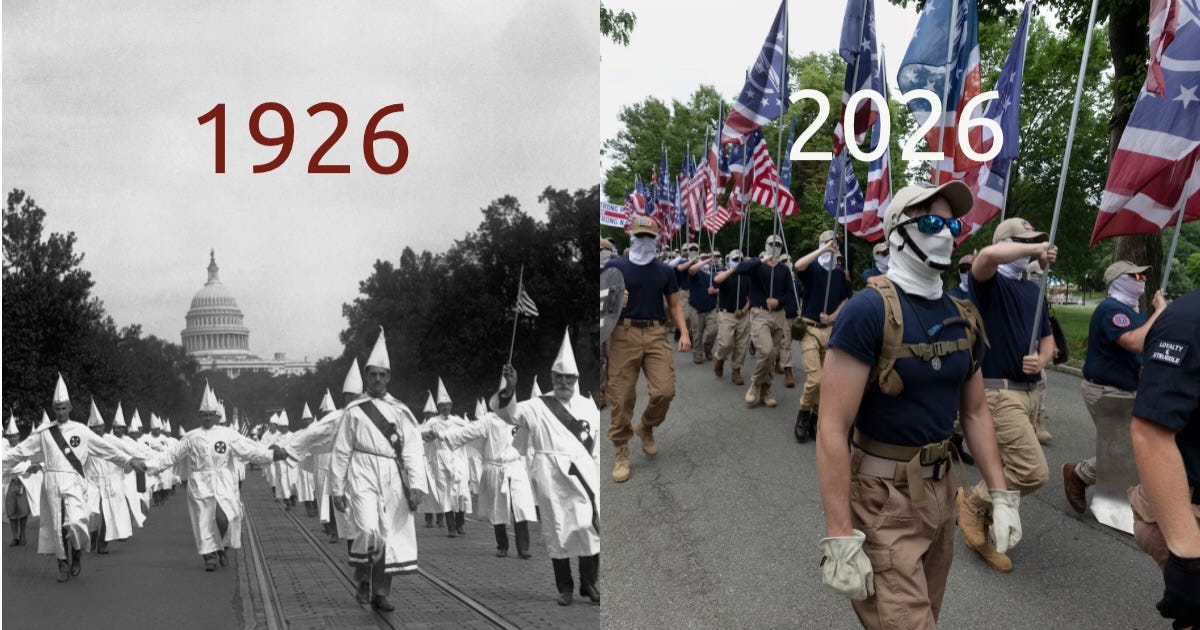
The 1920s were the second golden age of the Ku Klux Klan. They had come to prominence after the civil war after the collapse of Reconstruction, when their mission was to prevent Black men from voting, and Black families from achieving economic parity with whites. Jim Crow helped them to succeed, and we are in the 150th anniversary of the abject violence that made it happen, which led to the creation of the Department of Justice; whose original mission was to protect formerly enslaved Black Americans from white violence:
Amos T. Akerman was an unlikely figure to head the newly formed Department of Justice. In 1870, the United States was still working to bind up the nation’s wounds torn open by the Civil War. During this period of Reconstruction, the federal government committed itself to guaranteeing full citizenship rights to all Americans, regardless of race. At the forefront of that effort was Akerman, a former Democrat and enslaver from Georgia, and a former officer in the Confederate Army.
Though the United States had had an Attorney General since the formation of the government in 1789, none had been empowered with the full force of a consolidated legal team quite like Akerman. And none had had the monumental task of enforcing the 14th and 15th Amendments and new legislation delivering long overdue rights to four million formerly enslaved black men and women. This department’s work on behalf of the emancipated population was so central to its early mission that Akerman established the department’s headquarters in the Freedman’s Savings Bank Building.
In the immediate wake of the Civil War, Akerman, a New Hampshirite who had settled in Georgia in the 1840s, looked to the future, leaving the Democrats for the Republicans and prosecuting voter intimidation cases as a U.S. district attorney in his adopted state. Reflecting on his decision to switch his allegiance to the party of Lincoln, Akerman said, “Some of us who had adhered to the Confederacy felt it to be our duty when we were to participate in the politics of the Union, to let Confederate ideas rule us no longer….Regarding the subjugation of one race by the other as an appurtenance of slavery, we were content that it should go to the grave in which slavery had been buried.”Akerman’s work caught the attention of President Ulysses S. Grant, who promoted the Georgian to Attorney General in June 1870. On July 1 of that year, the Department of Justice, created to handle the onslaught of post-war litigation, became an official government department with Akerman at its helm. The focus of his 18-month tenure as the nation’s top law enforcement official was the protection of black voting rights from the systematic violence of the Ku Klux Klan. Akerman’s Justice Department prosecuted and chased from Southern states hundreds of Klan members. Historian William McFeely, in his biography of Akerman, wrote, “Perhaps no attorney general since his tenure…has been more vigorous in the prosecution of cases designed to protect the lives and rights of black Americans.”
Yet despite the federal government devoting an entire agency to protecting the formerly enslaved from what amounted to domestic terrorism, the Klan revived, full force in the 1920s, thanks to Democratic president Woodrow Wilson. From The Bill of Rights Institute:
During the 1920s, cultural conflict and modernization helped resuscitate the Ku Klux Klan (KKK). Whereas the original KKK was a violent, racist organization born in the post Civil War South, the modern Klan was driven by somewhat different concerns. Many white, lower middle-class, Protestant Americans in the North and Midwest were fearful that immigrants were changing traditional American culture, and they responded with anti-Catholicism and anti-Semitism.
The revival of the Klan was inspired by Birth of a Nation, director D. W. Griffith’s violently anti-black blockbuster film of 1915 that promoted the southern “Lost Cause” view of the Civil War. The movie was one of the most controversial films ever made and was based on the 1905 novel The Clansman by Thomas Dixon, Jr. On Thanksgiving Day, 1915, Colonel William J. Simmons and a few friends burned a cross on Stone Mountain near Atlanta to signal the revival of the Klan as one of many fraternal groups, but it harkened to an earlier Ku Klux Klan that often fought violently against rights for freed African Americans in the post-Civil War Reconstruction South.

The new Klan retained its namesake’s antipathy to blacks and its penchants for secrecy, the wearing of masks and sheet-like outfits, and vigilante-style violence. It also employed a special terminology for members, inventing words that began with the letter “K” such as “Kloran” (its handbook), “Klavern” (a local branch), and “Kludd” (a chaplain). It charged $10 to join (of which recruiters got a cut) and held a monopoly of selling Klan uniforms and regalia to members. As KKK membership grew into the millions by the early 1920s, the money poured in.
This “second” Klan could easily be as violent as its Reconstruction Era ancestor, but it was more fraternal and social, though its brand of socializing was restricted to native-born, Protestant whites. It supported the recently enacted national prohibition on alcoholic beverages and opposed labor unions, immigration, and foreign entanglements such as the League of Nations. Klan members and leadership disliked Wall Street and big business in general, and chain stores in particular. Said national Klan leader Hiram Evans, “Increasing economic inequalities threaten the very stability of society.” The rise of industrialism and consumerism presented bewildering changes that the Klan blamed on stereotyped Jewish bankers on Wall Street.
Unlike the early Klan (or the Klan of the 1960s), the 1920s Klan, although founded in the South, was not exclusively southern. It boasted support nationwide, primarily in the Midwest. In 1924, more than 40 percent of all Klan membership could be found in just three states (Ohio, Indiana, and Illinois), but the Klan also secured significant support in Maine, Colorado, and Oregon (where it helped ban Catholic schools). It enjoyed a small-town base but also appealed to big-city Protestants, with large chapters in such cities as Chicago, Detroit, Pittsburgh, Dallas, and Indianapolis. In the South, most members were Democrats. In the North (such as in Indiana), most were Republicans, though Milwaukee had a fairly large Socialist membership.
And the Klan was so prolific, they were thoroughly represented in both parties. In Colorado, both the Democratic mayor and the Republican governor were high level members of the Klan. And the notion of being in the Klan was not something that people hid. People were members right out in the open. So open: the Klan consumed the 1924 Democratic national convention (better known as the Klanbake” and marched through Washington in 1926.

And yet, the United States never created a domestic terrorism statute to deal with entities like the Klan, or with its modern counterparts: the neo-nazis, Patriot Front, Boogaloo Bois, Oath Keepers and Proud Boys, whose “Western Chauvinist,” anti-immigrant ethos is now deeply rooted in the federal government, thanks to people like Stephen Miller, Steve Bannon, Tom Homan, and Donald Trump.
Two can play at that game
Well imagine, if you would, if the next Democratic president, and Democratic governors starting in 2029, were to take what Trump and governors like Ron DeSantis have done to their invented domestic enemy “Antifa” and apply to the genuinely dangerous far right ideology known as MAGA. Namely: designate it as a domestic terrorist organization. Sounds crazy? Behold, America’s most pinch-faced governor… Listen to the whole thing if you can stomach it, and not the whingeing about the Southern Poverty Law Center and its designation of right wing groups as nazi affiliated and curious. The whole stream of right wing complaints that are spewed by this man.
But as the one journalist with good sense asked, why couldn’t a future Democratic governor reverse that designation and turn it on right wing groups like MAGA?
Next, recall Donald Trump’s insane presidential memorandum dated September 25, 2025 and entitled: Countering Domestic Terrorism and Organized Political Violence, which designates any group or individual as a domestic terrorist for the following thought crimes:
…anti-Americanism, anti-capitalism, and anti-Christianity; support for the overthrow of the United States Government; extremism on migration, race, and gender; and hostility towards those who hold traditional American views on family, religion, and morality…
So basically, if you believe trans people are real, that Black history shouldn’t be erased or that immigrants should not be kidnapped off the street by armed, masked men, or if you find right wing fake Christianity to be repugnant, you are, to this regime, a terrorist.
So what’s stopping the next Democratic president from issuing a similar directive at MAGA? After all, this is a movement that encourages hatred toward and vicious, conspiratorial lies about racial minorities and non-white immigrants, which has encouraged violent threats against them, demands that immigration be limited to white people from Europe and white South Africans, attacks trans individuals, setting them up for verbal and even physical attacks, and venerates the anti-American, treasonous Confederate States of America, including flying their flag—the flag of an enemy country that fought against the United States. To say nothing of the fact that this far right extremist group already attempted to overthrow the government, and their crimes are on tape.
After all, their adherents literally marched through Washington D.C. on the nation’s 250th birthday like the Ku Klux Klan of old:
… only with more ridicule…
Still, what’s to stop Democrats from designating MAGA as a domestic terrorist organization if and when they regain federal power, or in the states where they hold power now? After all, MAGA right wingers wear common insignia, not unlike a street gang…


… they can be identified by common tattoos, often reflecting crusader ideology. And these often Christian nationalist organizations (which is what the Klan is) align ideologically with billionaires who openly declare their opposition to democracy. I think there’s a strong case to be made by a future Democratic president, congress and pro-democracy governors. These right groups are far more organized and aggressively marketed to young white men in particular than the loose confederation of anti-fascists that call themselves “ANTIFA.” They have a far deeper and larger history of actual violence.
And the statistics are clear — at least when not suppressed by this regime — it is far right, not far left groups that pose the greatest threat of domestic terrorism in the U.S.
So why not back up these facts with an official designation?
The fight for birthright citizenship is not over
Worth a read: this excellent piece for The Root by activist Dorian Warren and Cook County Commissioner Josina Morita of Illinois, on how the narrow victory for the 14th Amendments plainly-written section one is just round one of the fight for Americans of color:
Birthright citizenship was not handed to Black Americans and later borrowed by immigrants. It is one promise — forged in the fire of Reconstruction to secure Black citizenship, and extended in 1898, in United States v. Wong Kim Ark, to protect the American-born children of the very Chinese immigrants the nation had tried to exclude. Black, Asian, and immigrant Americans do not hold separate stakes in the Fourteenth Amendment. We hold one.
Which is why, in Justice Thomas’s dissent, we heard something beyond a legal argument. We heard permission — permission to do to today’s families what was done to Josina’s more than a hundred years ago: to deny birthright citizenship not under the Constitution, but around it. Not by amendment, but by argument and by statute. The ruling did not close the question so much as keep it alive, inviting the next challenge forward. And what begins as a fight over immigrants rarely ends there. It reaches Asian Americans, and Black Americans, and anyone some official decides does not fit the fabric of the country.
We know this because it has already happened.
Josina’s great-grandmother, Mary Wing, was born in the United States. So were her parents. She was born a U.S. citizen. But when she married Fung Gum Wing, a Chinese immigrant, the collision of race and gender in federal law took her birthright citizenship away. Under the Chinese Exclusion Act, her husband was an “alien ineligible for citizenship.” Under the Expatriation Act of 1907, a woman was made to assume her husband’s nationality — or, in Mary’s case, his lack of one.
Mary did not lose her citizenship under the Constitution. She lost it by act of Congress. And that is exactly where the next fight will be fought. In Congress.
For twenty years, Mary was stateless — without constitutional rights or protections in the only country she had ever known. Her parents were citizens. Her children were citizens. She was not. In the 1930s, under amendments to the Cable Act of 1922, she was finally able to apply for citizenship. She applied as any immigrant would. She took the citizenship test. In 1939, her naturalization certificate arrived. Under “former nationality,” it reads: “American.”
An American, made to prove she was one.
The danger the dissent flirts with is not abstract. Strip the Fourteenth Amendment of its plain meaning, and Black Americans could once again be asked to carry papers to prove their freedom — Social Security cards, birth certificates, documentation of belonging — in a country that already over-polices and over-surveils them. The same logic that unmade Mary Wing’s citizenship is the logic that would have unmade the citizenship of Dorian’s ancestors, had the Court gone the other way. It is the same fight. It always has been.
And if you think it couldn’t happen again, you haven’t been paying attention. Stephen Miller, freed from the scrutiny of the Southern Poverty Law Center, which called him out on his nazi-curiousness, along with the ironic Marco Rubio, whose parents were foreign non-citizens when he was born, the soulless Todd Blanche, the goons at DHS including Tom Homan and Markwayne Mullin, not to mention right wing members of congress, are already studying Thomas’ dissent for instructions on how to come back with a case John Roberts thinks he can get past his dinner guests.
Hell, maybe Uncle Clarence delivered his instructions in person…
Have you subscribed to The Joy Reid Show yet? Well here’s your chance! Click here and subscribe now and support our independent media channel, and don’t forget to tick the little bell and hit “ALL” to make sure you never miss a live show! We stream the show from 6- 8 p.m. Eastern Standard Time, Mondays, Wednesdays and Fridays on YouTube, Substack and Twitch, with special bonus episodes and shorts, too! You can also enjoy the show as an audio podcast on Spotify of anywhere you get your podcasts. See you there! And don’t forget to subscribe here at Joy’s House too, which you can do quickly and easily below: